The Story of Ann Tecla Gillis
My aunt Ann's emails were almost always about the weather. Reading them after her death, I began to understand what she had been offering all those years.
My aunt Ann died on Friday, September 18, 2026. Unexpectedly. Tragically. And in circumstances I still struggle to comprehend.
She was on her way home, stepping off the Red Line on Boston’s T, when she apparently suffered some kind of medical event. We were told she fell from the platform and struck a moving train, although she sustained no serious injuries from the impact. She was pronounced dead upon arrival at the hospital.
We don’t know what caused her death. I’ve decided to believe Ann suffered a sudden, painless heart attack and was already gone before she struck the train or the ground. I have no evidence that this is what happened, but the alternative is too horrifying to contemplate. Without answers, this is the story I’m choosing to live with.
Perhaps there are times when the stories we tell ourselves are less about knowing the truth than finding a way to bear what we cannot know.
I learned of Ann’s death the following afternoon, when my mom’s younger sister called with the news. I was devastated. I was supposed to see Ann in two weeks, during a work trip to Boston, and we’d already planned to have dinner together. I was looking forward to catching up and checking on how she was doing.
Ann didn’t have an easy life. She lived with significant health challenges from birth, which shaped much of her experience. She never married or had children, but she built a life grounded in her Catholic faith, friendships, and church community. I always took comfort in knowing she had people around her who cared about her, even as I remained far away.
There is something uncomfortable in that admission.
I wonder now whether knowing Ann had a community around her made it easier for me to accept the distance between us. My parents moved us away from Boston when I was young, and by the time I was eight, I’d lived in four states. We eventually settled in Texas, and Boston became a place we visited during summer vacations. Physical distance was a familiar part of our family relationships, and I think I came to accept a certain amount of emotional distance as well.
When I grew up and started a family of my own, I made an effort to return to Boston regularly, bringing my husband and son to visit the people and places that were part of who I am. Ann was part of that. Our relationship was meaningful, even if our contact was infrequent. I knew she loved me, and I loved her.
Still, I had assumed there would always be another visit, another dinner, another opportunity to connect.
The afternoon I learned of her death, I drove to my parents’ memory care community to tell my mom that her older sister had died. My mom lives with Primary Progressive Aphasia, and I wasn’t sure how she would receive the news. She seemed unable to fully comprehend what I was telling her and didn’t cry until we called her younger sister, whose tears seemed to evoke her own.
The following morning, my mom fell while walking back to her room from the dining room and was taken to the emergency room after hitting her head. Thankfully, she was unhurt. I couldn’t help wondering whether Ann’s death had something to do with the fall, whether my mom was somehow trying to process the loss of her sister.
I don’t know. But I resist the idea that because she cannot articulate her grief, she isn’t experiencing it.
In the days that followed, I stepped into a familiar role—one that has tried to define me over the years.
I took care of things.
I changed my travel plans and flew to Boston a week earlier than my work trip required. My aunt and I began managing Ann’s affairs, which meant emptying her apartment, closing accounts, notifying creditors, completing paperwork, and making arrangements.
Death leaves an astonishing amount of administrative work for the living. And I knew how to do it. Caregiving, I’ve come to realize, develops a remarkable set of skills, acquired not through training or ambition, but through necessity.
I was glad to be there for my aunt and to take some of the burden from her. But managing Ann’s affairs also gave me a way to be with her. Every document and personal possession offered a glimpse into the ordinary life she had lived.
There is an intimacy in tending to what someone leaves behind, and perhaps also some relief in having something to do.
I recognize this tendency in myself. When something difficult happens, I become capable. I organize, coordinate, and manage. There is genuine care in that, but I also wonder whether it sometimes protects me from the helplessness of grief.
During that week, my aunt asked me to write and deliver Ann’s eulogy. I said yes without hesitation.
And then I hesitated.
What did I have to say about Ann? I loved her, certainly, and I had memories of her, but did I know her well enough to stand before the people who had shared her everyday life and tell her story? I felt nervous and ashamed of how distant I had been, and how little I knew about the ordinary details of her life.
I decided to look through our emails for inspiration. I’m one of those people who rarely deletes anything, so a search for Ann’s name brought up hundreds of messages spanning at least five or six years.
And there, in those emails, I found Ann.
The subject line of so many of her emails was simply:
Weather.
Ann followed the weather everywhere her family lived. She noticed when temperatures in Boston, Maine, Colorado, and Arizona were unusually similar, when we were all experiencing rain, or when Colorado was somehow warmer than Massachusetts.
Sometimes her emails weren’t really about the weather at all. She might mention something she’d watched on television, a doctor’s appointment, an old friend, or someone’s birthday. She once reported that Boston was overrun with soccer players and Scots in kilts. Another time, she alerted the family to the closing of the S&S Restaurant in Inman Square, complete with a crying emoji.
For years, I’d understood these emails as Ann sharing whatever happened to be on her mind. But reading them after her death, I began to understand them differently.
Ann was keeping us connected.
Our family had scattered across the country, living separate lives hundreds and sometimes thousands of miles apart, and Ann kept finding something we shared. Sometimes it was nothing more than a rainy Friday, but she noticed, remembered, and reached out.
I thought about how often I’d received those emails without responding. Sometimes I did, of course, but often I was distracted by the demands of my own life. I hadn’t recognized what she was offering.
The emails hadn’t changed, but something in my own listening had.
What once seemed like ordinary updates about the weather now revealed an expression of love I hadn’t fully appreciated. I wished I’d understood it sooner and reached back more often.
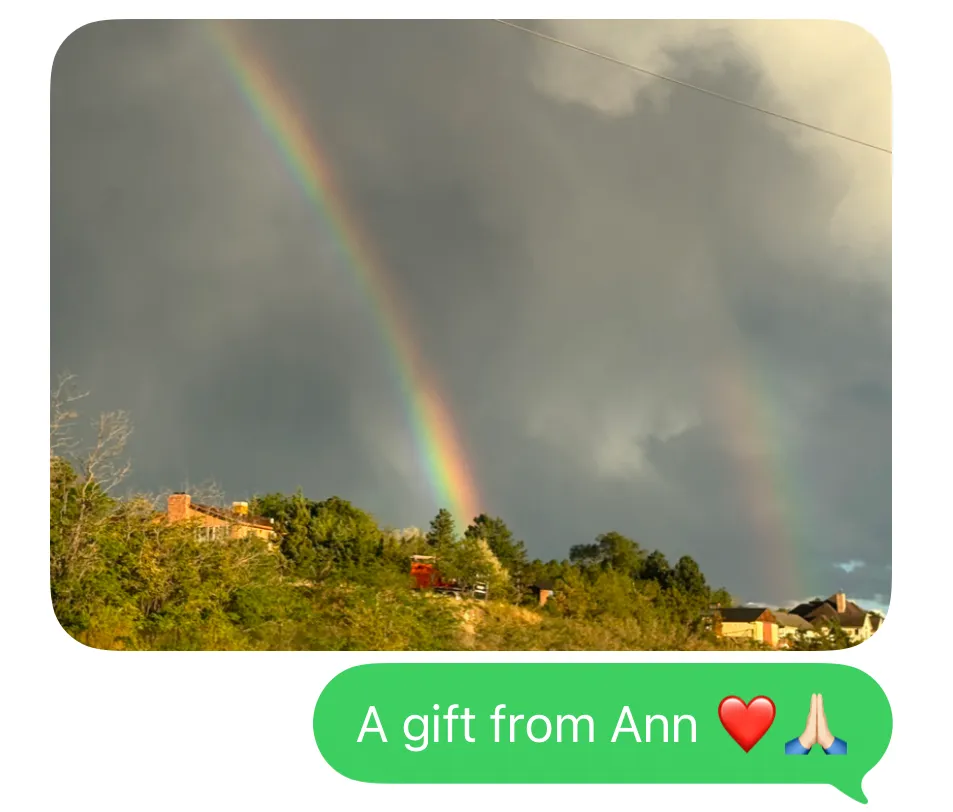
The evening after I learned of Ann’s death, a double rainbow appeared in the Colorado sky. I took a picture and sent it to my aunt with four words:
A gift from Ann.
At the time, I hadn’t read through her emails or recognized how she’d spent years looking at the weather where each of us lived, noticing the moments when our separate skies seemed somehow connected. Yet there I was, looking at the sky and reaching out to someone Ann loved.
I was speaking her language before I knew what it was.
Then I found an email from 2023 in which Ann had noticed that Wells, Boston, Aurora, and Lakewood were all experiencing similar temperatures. She ended it with a question:
“Are we united in any other way?”
I found that question extraordinary. I doubt Ann intended it to be philosophical. She was simply noticing the weather and wondering aloud about the people she loved. But it captured something about her that I hadn’t fully understood. Ann cared about connection, about remembering and being remembered, and she had been expressing that care in a language uniquely her own.
I had been carrying shame about my distance from Ann, about the dinner we would never have and the conversations we would never share. Her emails offered another way to see our relationship. Not one that erased my regret, but one that allowed me to recognize what had been present alongside that distance.
Ann had loved me. She had loved all of us.
I delivered Ann’s eulogy at Saint Cecilia’s Church in Boston, surrounded by the family, friends, and parish community who had known and loved her. I spoke about her faith, independence, kindness, and the enormous bear hugs she gave my brother and me when we were children. I spoke about how she’d become my godmother and how I carry the name of one of her dearest childhood friends.
And I spoke about the weather, ending with the question she’d asked us three years earlier.
Are we united in any other way?
Yes, Ann. We were. We are.
On the morning of the day she died, Ann had sent one final email to the family. The subject line was, appropriately enough, Weather. She compared temperatures in New England and Colorado, mentioned her allergies, proudly reported beating her Spider Solitaire record, and remembered that my brother’s birthday was the next day.
Until the last day of her life, she was paying attention to the people she loved and reaching across the distance.
I have thought a great deal about Ann since returning home. There is sadness about the dinner we never had and regret about the opportunities I allowed to pass. I don’t want to explain those feelings away, but I am beginning to see our relationship differently. Ann’s emails have me wondering how often we overlook the ordinary ways people express their love, particularly when those expressions don’t resemble what we’ve come to expect.
I also don’t want to turn Ann’s death into a lesson. Her life was more than an occasion for my personal growth. She was a woman who loved her city, her church, her friends, and her family. She was independent, determined, and kind.
She was my godmother. She was Ann. And I miss her.
I cannot change the years that have passed or recover the dinner we were supposed to share. But I can pay attention now, to the small gestures and ordinary invitations that are so easy to miss when life is full and our attention is elsewhere.
And I know that the next time I look at the sky, I will think of Ann.
Not because I believe she’s sending me a message through the weather, but because, in her own quiet and persistent way, she taught me to notice how we’re connected.
Written by Ti Mougne